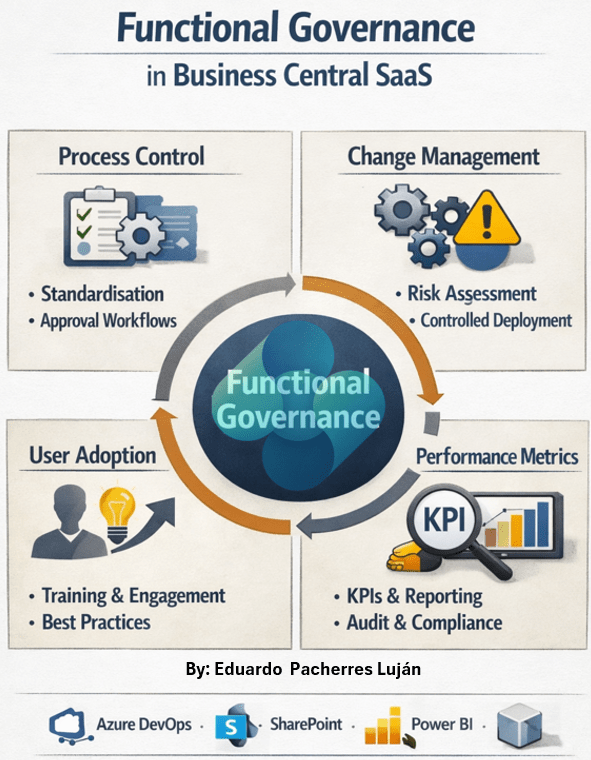
Functional governance in Business Central SaaS is not an abstract concept: it is the discipline that ensures the ERP evolves in an orderly, sustainable manner that is aligned with the business.
Without governance, Business Central becomes a collection of patches.
With governance, it becomes a living platform that drives decisions.
Functional governance in Business Central SaaS is not an abstract concept: it is the discipline that ensures the ERP evolves in an orderly, sustainable manner that is aligned with the business.
Without governance, Business Central becomes a collection of patches.
With governance, it becomes a living platform that drives decisions.
1. What functional governance really means in Business Central SaaS
It is the framework that guides how processes are designed, how changes are approved, how responsibilities are assigned and how the ERP evolves over time.
Good governance answers questions such as:
- What is the business impact of this change?
- What is the ERP impact?
- Who approves it?
- How is it documented?
- How is it measured?
- How does it affect future scalability?
Governance is the invisible architecture that keeps Business Central healthy.
2. Real examples (practical cases)
✔ Case 1: Inventory configuration changes
Without governance:
- valuation inconsistencies,
- accounting discrepancies,
- blocked internal audits.
With governance:
- impact assessment,
- sandbox testing,
- documentation,
- committee approval,
- controlled deployment.
✔ Case 2: Proliferation of custom fields
Without governance:
- duplicated data,
- reporting confusion,
- uncontrolled growth of customisations.
With governance:
- validation of need,
- review of standard functionality,
- ownership assignment,
- usage policy.
✔ Case 3: Financial processes
Without governance:
- inconsistent month‑end closing,
- unclear roles,
- hidden dependencies.
With governance:
- RACI matrix,
- closing checklist,
- defined functional roles,
- smoother internal audits.
3. How to measure functional governance (real tools and KPIs)
✔ Key functional indicators
- % of documented processes
- % of changes approved through governance
- Number of incidents caused by misconfiguration
- Number of functional exceptions
- Adoption time for new features
- Ratio of standard vs customised processes
✔ Tools that support governance
- Azure DevOps – change control, approvals, backlog
- SharePoint – functional documentation repository
- Power BI – adoption and usage dashboards
- Copilot Studio – automated functional queries
- Sandbox environments – controlled testing before deployment
4. Adoption: the real thermometer of governance
Governance is not measured in documents.
It is measured in user behaviour:
- Do users follow the designed process?
- Do they avoid shortcuts?
- Do they understand the impact of their decisions?
- Do they participate in functional committees?
- Do they request changes with proper criteria?
A well‑governed ERP has mature users, not just trained users.
5. My experience as a Functional Consultant and MCT
Across projects, I see the same pattern:
The organisations that succeed with Business Central SaaS are not the ones that customise the most, but the ones that govern the best.
Functional governance is:
clarity, responsibility, sustainability and evolution.
It is the bridge between technology and business decision‑making.
To Conclude
Business Central SaaS does not need more customisations.
It needs stronger governance.
Let’s keep building value.

Deja una respuesta