Microsoft Fabric introduces a fundamental shift in how functional teams interact with data, analytics and decision‑making. Copilot is not merely an AI assistant; it is a new operating model for business users, analysts and consultants who work with data every day.
For years, functional roles relied heavily on technical specialists to transform data, validate models or build reports. Fabric changes that dynamic. Copilot empowers functional professionals to participate directly in the data value chain — without needing deep technical expertise.
1. Functional roles now participate in data engineering
Copilot enables functional roles to:
- generate transformations,
- clean and prepare data,
- create pipelines,
- explain code,
- detect errors,
- validate flows.
All without needing to write Spark, SQL or DAX.
Functional example
An analyst notices inconsistent values in the “CustomerSegment” field. Previously: they opened a ticket and waited. Now: they ask Copilot to review the transformation and identify where the inconsistency originates. The engineer steps in only for the final correction.
2. The functional consultant becomes a designer of context
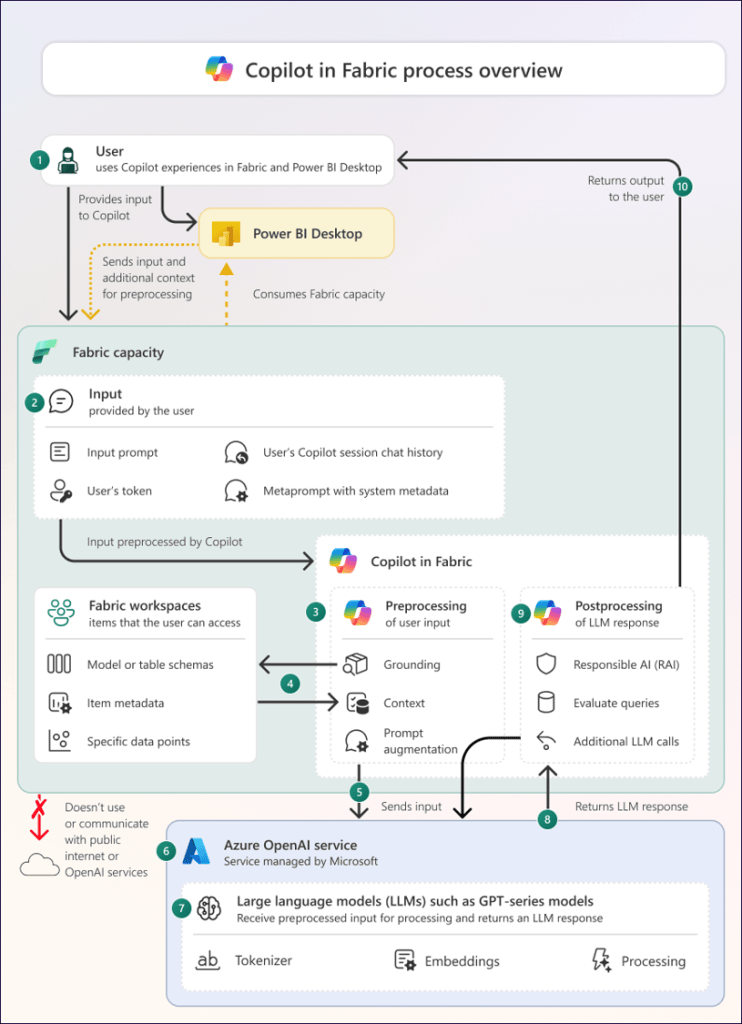
Copilot works through context, not magic. This means functional consultants must now:
- guide how questions are formulated,
- define clear instructions,
- validate Copilot’s responses,
- understand token processing and consumption,
- design prompts for Fabric Data Agents,
- translate business processes into natural‑language queries.
Functional example
A manager asks:
“How is the campaign performing?”
Copilot returns a vague answer. The functional consultant reframes the question:
“Compare conversions and cost per channel for Campaign X over the last quarter.”
The insight becomes precise and actionable.
3. Power BI evolves from reporting to conversation
Copilot transforms Power BI into a conversational analytics tool where:
- users ask questions,
- reports respond,
- functional consultants guide the interaction,
- semantic models become a shared language.
Functional example
A finance director asks:
“What is the EBITDA variance by region over the last six months?”
Copilot produces:
- a visual,
- a narrative summary,
- an explanation of the trend.
The functional consultant ensures the semantic model supports the question correctly.
4. Fabric Data Agents: the biggest functional leap
ºFabric Data Agents allow any user to:
- ask questions in natural language,
- receive contextual answers,
- without opening Power BI,
- without SQL,
- without DAX.
Functional consultants design:
- instructions,
- examples,
- constraints,
- tone,
- user experience.
Functional example
An operations manager asks:
“Which plant had the most production delays this month?”
The agent responds with:
- a table,
- a chart,
- a contextual explanation,
- an additional insight.
5. Functional roles must now understand cost, capacity and consumption
Fabric introduces a new concept: cost per token.
Functional professionals must now:
- recommend when Copilot should be used,
- avoid unnecessary prompts,
- optimise consumption,
- understand capacity strategies,
- advise on scaling decisions.
Functional example
A team uses Copilot to generate long, complex SQL queries. Consumption spikes. The functional consultant recommends:
- shorter prompts,
- splitting questions,
- using Data Agents for repetitive queries.
To conclude
Fabric does not simply modernise technology. It reshapes how functional roles work with data, insights and decision‑making.
Copilot turns functional professionals into:
- context designers,
- question architects,
- decision facilitators,
- insight enablers.
This is the new functional landscape in Microsoft Fabric — one where business users and consultants play a central role in the analytical process.

Deja un comentario