Final chapter of the series «The Evolving Functional Role in Microsoft Fabric»

Throughout this series, we have explored how Copilot is transforming the way functional professionals engage with data. We have seen how it assists with data preparation, helps uncover insights and enables a deeper understanding of business information.
But all these advances ultimately lead to a much larger question:
What happens when users stop searching for information and information begins responding directly to them?
1. For Decades, We Learned to Speak the Language of Machines
The history of business analytics is, in many ways, the history of translation.
Business leaders think in questions.
Systems respond in technical language.
Between these two worlds, there has always been a layer of intermediaries:
- Business Analysts
- BI Specialists
- Data Engineers
- Data Analysts
- Solution Architects
When a Commercial Director asked:
«Why is profitability declining?»
the organisation typically translated that question into:
- SQL queries
- Data models
- Measures
- Business rules
- Visualisations
- Reports
Technology evolved.
The translation layer remained.
Despite major advances in analytics platforms, the process still required users to understand where information lived, how it was structured and how to navigate it effectively.
That dependency became the hidden cost of data-driven organisations.
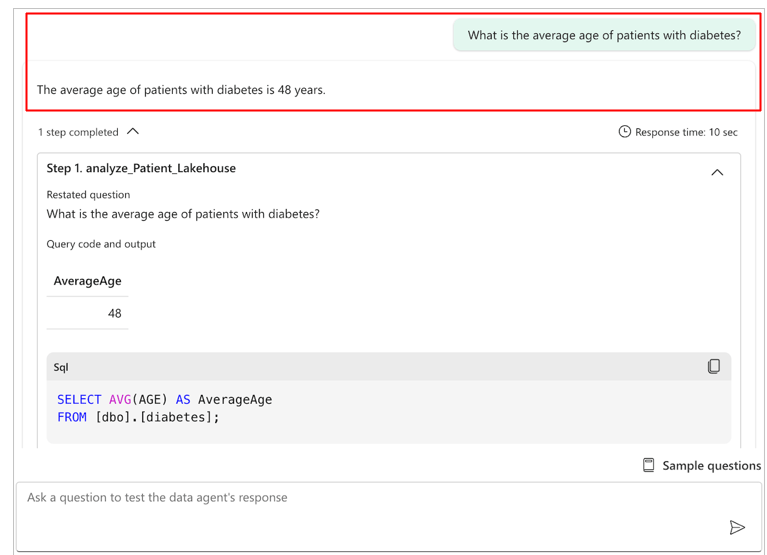
The image visually represents the transition from data exploration to natural conversation.
2. The Real Revolution Is Not Artificial Intelligence
A common misconception exists across the industry.
Many professionals believe the breakthrough lies in generating queries more quickly or creating reports more efficiently.
That is not the fundamental shift.
The true transformation lies in the removal of complexity.
For the first time, business users can focus entirely on their objectives rather than the technology required to achieve them.
They no longer need to understand:
- SQL
- DAX
- Data structures
- Table relationships
- Data warehouses
- Lakehouses
- Semantic models
Instead, they focus exclusively on the business question.
The platform determines how to answer it.
The experience changes from navigating technology to expressing intent.
The complexity does not disappear.
It becomes invisible.
Functional Example
A Finance Director asks:
Which product categories have experienced the largest margin decline this quarter compared with the same period last year?
Traditionally this would involve:
- requesting a report,
- validating assumptions,
- waiting for analysis,
- reviewing multiple visualisations.
Now the interaction begins with a simple question.
The conversation replaces the process.
3. Semantic Models Become Organisational Knowledge
Traditionally, semantic models were designed to support reporting.
Their primary purpose was to provide consistency across dashboards and analytical solutions.
Today their role is becoming significantly more important.
Organisations are increasingly building semantic models not just for users but for intelligent systems.
This changes everything.
Semantic models are no longer simply:
- analytical structures,
- governance mechanisms,
- metric repositories,
- reporting foundations.
They become representations of organisational knowledge.
They provide business context.
They define meaning.
They establish trust.
Most importantly, they enable intelligent systems to understand the language of the organisation.
In this new paradigm, the semantic model is no longer the destination.
It becomes the starting point for every conversation.
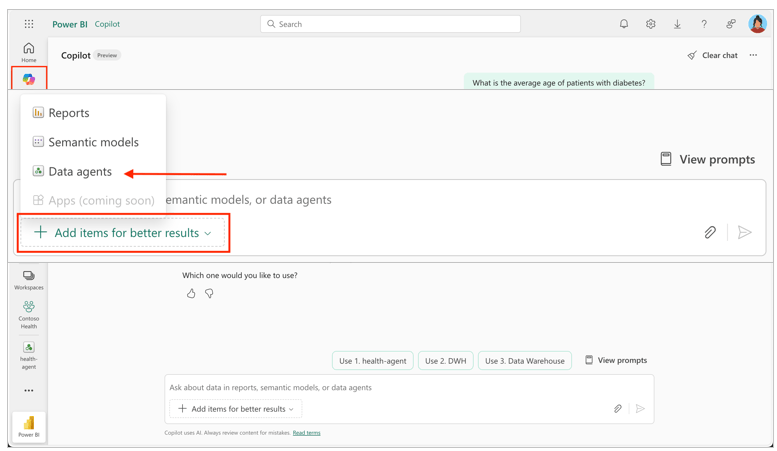
Semantic Model and Data Agent architecture
4. The Final Democratisation of Data
For years, technology vendors have spoken about democratising data.
Progress has undoubtedly been made.
Yet one challenge remained.
Users still needed to:
- locate reports,
- understand metrics,
- navigate pages,
- interpret visualisations,
- connect insights.
Even with self-service analytics, the burden remained on the user.
Conversational intelligence changes the equation.
Business users interact using the only interface they have mastered since childhood:
language.
They ask questions exactly as they would during a management meeting.
Examples include:
Which suppliers have increased costs most significantly this year?
Which customers are showing early signs of churn?
Which regions are exceeding their sales targets despite market contraction?
The barrier between data and decision-making becomes significantly smaller.
For many organisations, this may be the first genuine step towards universal data accessibility.
5. The Emergence of Enterprise Conversational Intelligence
Perhaps the most profound shift is not technical.
It is organisational.
Data is no longer confined to analytical platforms.
Intelligence begins to appear wherever employees work.
Imagine a sales executive opening Microsoft Teams and asking:
Which European customers present the highest revenue risk over the next quarter?
The system analyses organisational knowledge, business definitions and historical patterns.
The answer appears within the natural flow of work.
No dashboard.
No navigation.
No training course.
No technical intervention.
The user remains focused on decision-making rather than information retrieval.
This changes not only how analytics operates.
It changes how organisations think.
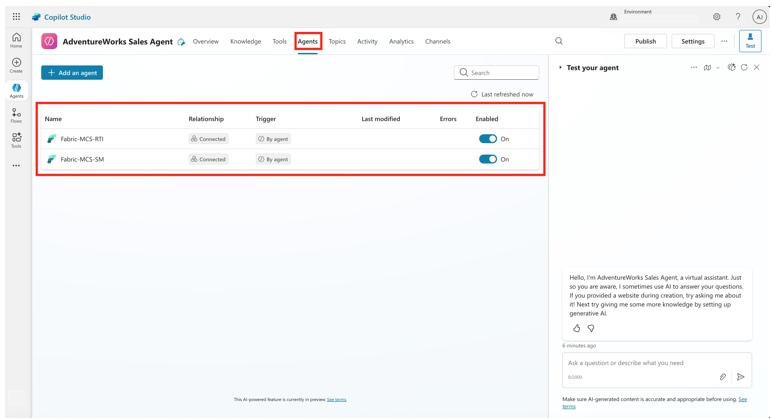
Data Agents integrated with Teams, Copilot Studio and enterprise applications
6. Will Analysts Become Less Important?
Quite the opposite.
As technology reduces technical barriers, business understanding becomes more valuable.
The competitive advantage shifts from:
«I know how to access information.»
to
«I know which questions matter.»
Professionals who understand:
- processes,
- operations,
- customers,
- finance,
- strategy,
will become increasingly important.
Technology can retrieve information.
Only people can define which problems are worth solving.
7. What This Means for Functional Professionals
Functional consultants have traditionally served as translators between business and technology.
That responsibility is evolving.
Less time will be spent on:
- explaining data structures,
- validating queries,
- navigating technical complexity.
More time will be devoted to:
- process design,
- governance,
- adoption,
- strategy,
- business transformation.
The role does not diminish.
It becomes more strategic.
The ability to frame problems correctly may become more valuable than the ability to build solutions.
To Conclude
Throughout this journey we have explored how intelligent technologies are reshaping the functional landscape.
We have seen how they:
- simplify complex processes,
- accelerate analysis,
- enhance decision-making,
- strengthen business understanding.
But perhaps the most significant transformation is this:
Data is no longer something we search for.
Data becomes something we speak with.
This is not merely the evolution of reporting.
It is the evolution of the relationship between people and information.
And once organisations begin having conversations with their data,
it becomes very difficult to return to searching for answers the old way.
Final Reflection
The next generation of business professionals will not be recognised for their ability to build reports. They will be recognised for their ability to ask better questions.

Deja una respuesta